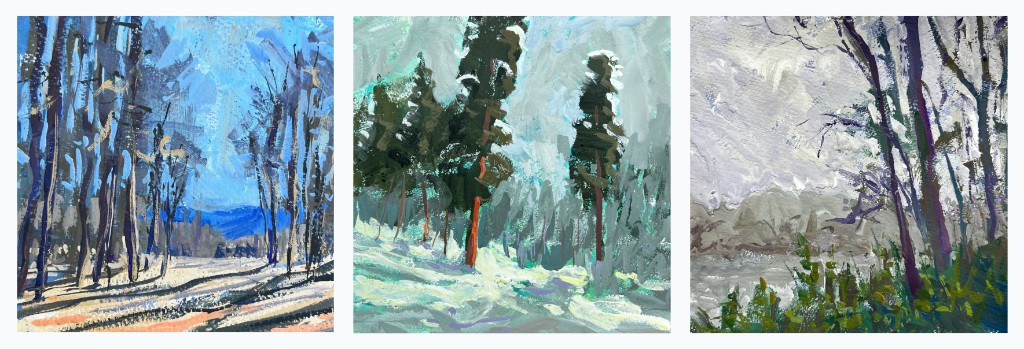
We painters try to capture more than shapes and colors. We try to capture the essence of a moment.
Wind moving through trees. Clouds churning in the sky. Light catching a distant mountain. Long shadows crawling across the ground. When I arrive somewhere to paint, there is usually a feeling in the landscape.
Something subtle that gives the place a quiet sense of energy.
To help capture this, I often prepare what I call an essence ground.
This creates movement and color harmony beneath the landscape. It captures the feeling of mana.
The Essence Ground
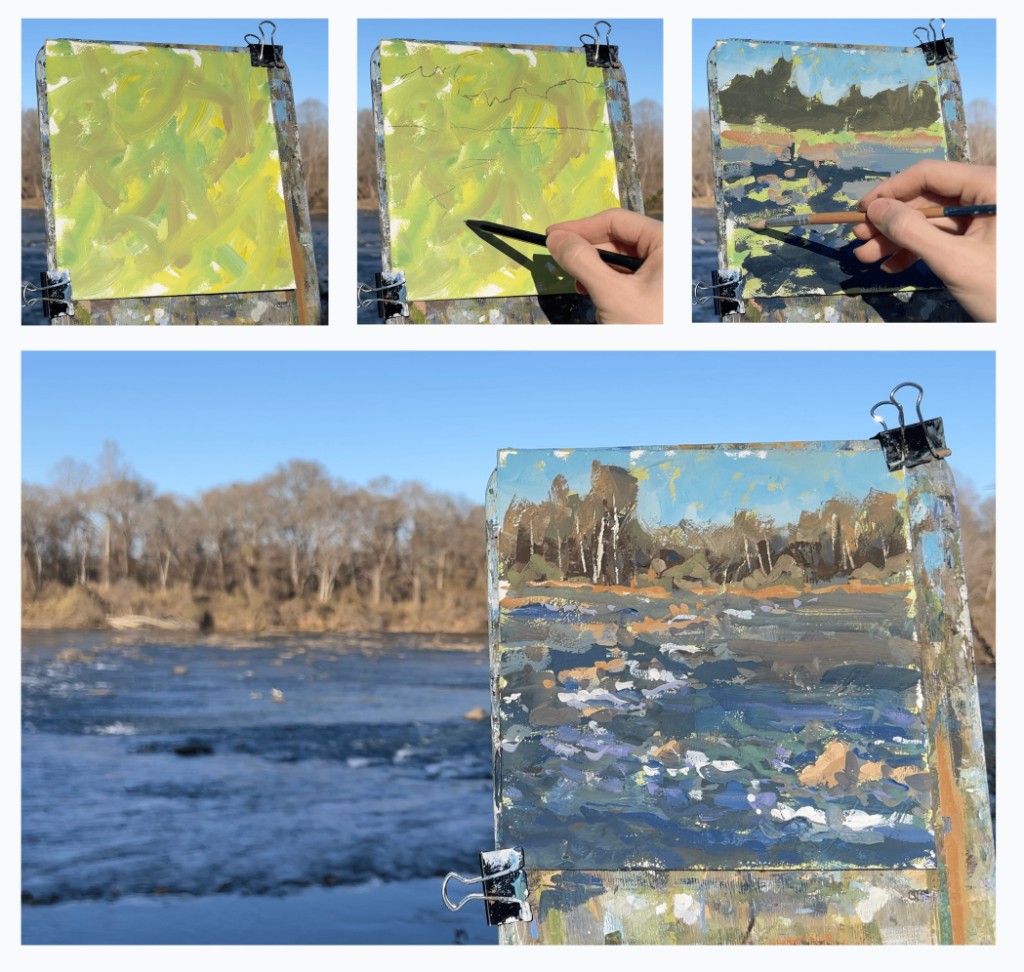
Before going outside to paint, I prepare several sheets of paper with an essence ground. I use a large round natural bristle brush. I mix acrylic paint with matte medium (to avoid gloss). Then paint that onto thick watercolor paper. I swirl the brush across the surface. This is not careful. It’s not precise. It’s bold. It’s playful. The goal is movement and energy. These swirls become a tonal foundation for the actual landscape painting.
Thick Cold Press Paper
Thick paper feels confident and strong. It won’t crinkle. It withstands the elements of outdoor painting. Cold press paper has texture that helps create broken paint application. The brushstrokes skip across the surface. Colors catch the peaks of the paper. This creates a painterly and impressionistic feel, which I find satisfying.
Essence Ground Colors
I prepare several sheets at once, and alternate colors along the way. Usually 1 or 2 colors plus white. Each sheet is slightly different. My favorite essence colors are purple, teal, blue, green, yellow, and yellow ochre. I prefer cool colors. For whatever reason, they feel closer to the natural energy I want to capture. I rarely use warm colors like red or orange. Those feel too cheery for my style. The essence ground works best in the light-to-mid value tones, and medium saturation. Just enough color to influence the painting that will sit on top.

Picking A Scene
When I decide to paint outside, I usually don’t know what to paint, just where. Maybe it’s the local park, or a spot with a mountain view, or a quiet field. When I arrive, I find a scene that feels interesting and approachable. I usually look for a few things. A strong composition with asymmetry, leading lines, rule of thirds, and clear high or low horizon. Something interesting that catches my eye, makes me pause, or invokes curiosity. A sense of energy and story, that feels alive or ephemeral. Nothing transcendental. Perhaps slightly mystical. Examples would be light hitting a tree trunk, moody clouds on a gray day, a deep sense of quiet enclosed in a forest, long shadows that outstretch their subjects.
Picking An Essence Ground
I bring several prepared sheets. Usually three or four different colors. Once I select the scene, I choose the essence ground that fits it. I usually hold two or three sheets against the scene and choose the one that feels right. Sometimes it’s a complementary color. Sometimes it matches the mood of the landscape. This decision guides the painting. The energy of the ground becomes part of the final work.
Painting On Top With Gouache
Then the actual painting process begins. I start with a simple line or shape sketch to establish the composition. The scratchy pencil is satisfying over the thick paper and acrylic paint. Then I paint directly on top with gouache. Gouache is perfect for this technique because it’s opaque, layers easily, and allows the ground to peek through as brushstrokes skip over the textured surface. This last part is important. I do not try to cover the essence ground completely. Small areas of the ground showing through add variety, movement, color harmony. And I just like the scratchy effect. The painting feels more alive when the foundation stays visible. I am not after refinement. Just enough to capture the moment. I paint fast and bold, which is the nature of plein air, as light changes, and my own energy dwindles while standing, concentrating, and enduring the outdoor elements.
Why I Use Essence Ground
The essence ground creates a layered structure. Each layer contributes something different. The paper is a strong surface with texture for broken brushwork. The Essence Ground creates movement, color harmony, and energy before the painting begins. The actual gouache painting adds light, shadow, the subject itself, location, and atmosphere. Most importantly, the technique supports how I think about painting. Every landscape has a subtle innate natural energy. I try to capture the essence of that moment. The ground adds feeling and movement that echoes that energy. I call this energy mana.
On Mana
There is a subtle, curious, esoteric feeling that exists in nature. It happens for many who pause and appreciate. I am not referring to anything spiritual. Definitely not religious. Just a small sense of natural energy. Many landscapes have a feeling. Maybe it’s the heaviness of fog, wind through swaying trees, or light shifting on cold ground.